Akāmu at IETF 126: Hackathon Interop Results
IETF 126 Hackathon and PLANTS
The Akāmu ACME framework was presented at the IETF 126 PLANTS working group meeting in Vienna on July 20, 2026. The presentation covered hackathon interop testing results and ongoing work on Merkle Tree Certificates. Slides are available on the IETF datatracker.
ACME Interop Testing
During the IETF 126 Hackathon, Akāmu was tested against a Lightkeeper, an upcoming ACME client developed by Corey Bonnell. The interop testing uncovered and led to fixes for two issues:
- Order state polling — client polling behavior when ACME order state changes.
- Certificate linter — handling of certificate requests missing a subject DN.
Both issues were fixed in Akāmu during the hackathon. These fixes and more RFC compliance work is already merged upstream.
Merkle Tree Certificates Progress
Work on Merkle Tree Certificates (MTC) continued at the hackathon:
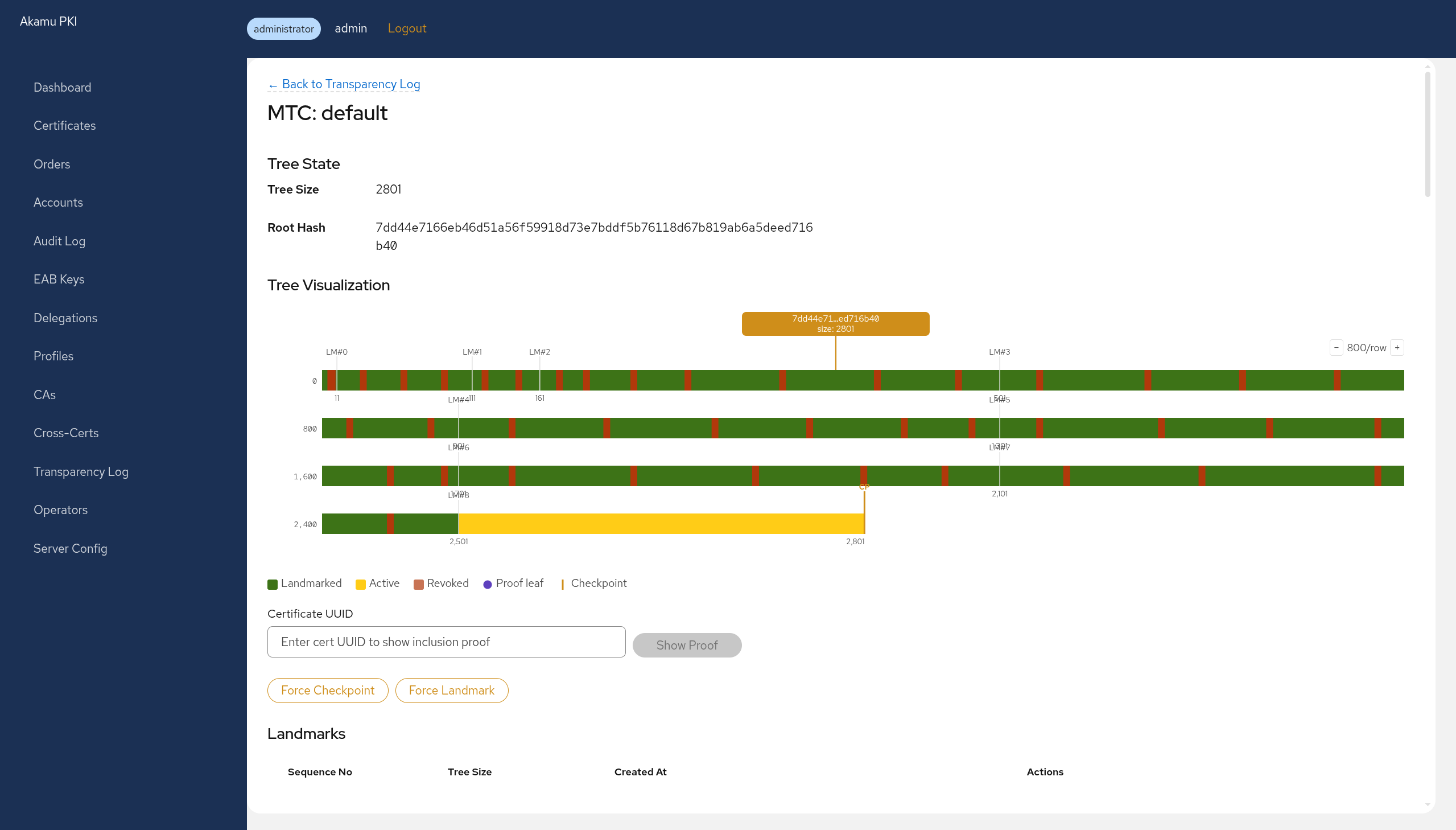
- A tree timeline visualization was added to help inspect MTC state.
- Improvements to t-log format support.
- Discussions with David Benjamin (PLANTS) on MTC design and with Bob Beck (OpenSSL) on Trust Anchor IDs.
Here is how tree timeline visualization looks like in Akāmu Web UI:
Ecosystem Collaboration
The hackathon also advanced integration with the broader Rust and cryptography ecosystem:
- Post-quantum algorithms — future PQ support via custom OpenSSL providers with the QUBIP Aurora framework. Amit Kumar from Ruhr University was able to produce FN-DSA support and plug it into Akāmu’s cross-signing demo. As a result, Akāmu issued certificates with FN-DSA signatures out of the box. Amit plans to submit a documentation explaining how to extend Akāmu with new methods.
- FIPS support — updating
native-osslto enablekrypteringandbergshamra(a Rust XML Security implementation) to use FIPS-validated OpenSSL (Kushal Das).
About QARC
Akāmu is developed as part of the QARC (Joint Post-Quantum Initiative) research project, funded by the European Union under Grant Agreement No. 101225691, supported by the European Cybersecurity Competence Centre.